Every time there is some high school project where a student
expresses a view outside the pro-cop paradigm – it raises controversy from the
pro-cop guardians and often at the behest of police unions. Here is a recent case in point, in Kentucky, not
in NJ but the similar dynamic plays out – an art project expresses a view
criticizing police shooting of Black civilians and then a big blowhard reaction
results against the student views. The
good news in this case is the principal did not have the project taken down.
I visited this topic in an article last June regarding the
police inspired repression of 3rd grade teacher (since fired)
Marylin Zuniga – repressed by police union inspired outcry after allowing a few
students to volunteer to write get well letters to Mumia Abu Jamal whose life
has been endangered by Pennsylvania prison authority medical neglect and other
police inspired actions against a humanities class assignment in South Jersey:
It seems the public schools will always be subject to this
kind of pressure and it seems police are always able to kick up a firestorm of
overly protective parental concerns that want to make sure their little Johnny
is not exposed to any views in the schools that questions the status quo around
issues of police impunity, mass incarceration and racial profiling in law
enforcement.
So how about we figure out a way to provide a venue – across
the whole state of NJ – in the windows and walls of community based
organizations – on our internet outlets – in printed media – and on the public
sound cloud to promote art, music, writing, etc. – by youth – that questions
authority and challenges police impunity, mass incarceration, etc? Seeking public space for a venue to exhibit
such creations can also provide gounds for struggle – around public space at
libraries and in public buildings. And
youth can be encouraged by our movements to express their dissent when the
message from within the corridors of the schools is mixed at best.
Is it possible? I
believe so – there are enough justice seeking organizations across the state of
NJ that have connections to students and working and unemployed youth.
I believe such a project – while it would be an undertaking –
would have the potential for great success and can possibly help encourage
expression among the youth which is often frustrated and confounded by the
stale dictates of public school administrations as they fall under the influence
of cop union big mouths and other blowhard guardians of youth conformity.
Any efforts needs to be inclusive as possible and include outreach across the walls into the incarceration facilities - both the juvenile and adult facilities.
Tyreem Henry - 34,5 years torture (solitary) for social
networking
Cell phones in prisons.
Guess what? It’s a thing! Lots of incarcerated have them. Lots of incarcerated use them to communicate
with each other. To post on
Facebook. To keep up with the
outside. To participate in internet
radio programs and broadcast websites.
To urge their brethren and sistern to organize. Or just to try to maintain some human
connection. Get over it.
And yes, some use them to pursue criminal activities as
well. But you know . . . if they are
using their phones for that purpose – and since all cell communications are
already monitored by federal agencies – it is the perfect way for agencies to
monitor any such criminal activities. So
the existence of the cell phone should make controlling any said crimes by the incarcerated
easier – not harder.
So we do not need boogey man stories about how cell phones
among the incarcerated is some sort of dangerous scourge. It is part of the incarcerated life. It is one of those things that makes many of
those incarcerated beholden to the authorities since there is always the
potential for a thorough search that could put a substantial percentage of the
incarcerated in deep trouble including years of solitary.
The presumption of the carceral state is that the public
naturally would go along with the ideology that it is a horrible thing for
incarcerated to possess and use cell phones and to participate in social
media. While there could be a strong
tendency – as decarcerators we need to SHOUT THAT DOWN! HELL NO!
“Tough on crime” rhetoric being used to pander to political base (and the
base-ist of politics) has run its day.
The current rhetoric is for reform, reduction to incarceration
rates. (Most such rhetoric honestly –
including both political parties – is more form – little substance – as the
ranks of incarcerated continues to grow, the local enforcement priorities of
minimalist offenses continues to proliferate, and the conjuring of new excuses
to incarcerate – like establishment democrat Rahm Emanuel’s proposal to jail
those who sell “loosey” cigarettes in Chicago for example – continue to
proliferate. But among at least sectors
of the public, there is no longer a knee jerk reaction of support for tough on
crime political pandering.
We need to apply this rejection to the idea that cell phones
in prison are to be severely punished.
And the punishment can be quite severe.
I refer to the case of
“Tyheem Henryreceived the harshest penalty to date.
Henry was handed down 13,680 days (37.5 years) in
disciplinary detention and lost 27,360 days (74 years) worth
of telephone, visitation, and canteen privileges, and 69 days of good time for
38 posts on Facebook. Others such asWalter Brown, who received34.5 years in
solitary and lost 69 years of phone, visits, and commissary privileges, were
handed down these sentences that have been termed “cruel and unusual
punishment” by human rights organizations.”
Read that a
couple of times and let that sink in.
37.5 years of solitary!
This is no
isolated incident either:
“A report from
the SCDC that was released earlier this month reveals that 432 similar cases
were placed against 397 inmates since the“Creating and/or Assisting With A Social Networking Site” Level
1 offense was implemented in 2013..”
First off –
solitary is torture and must end immediately.
While decarcerators should continue to press for abolition (in my case)
or reform (if that is your view) – we need to be steadfastly united toward the
immediate cessation of solitary – recognized as a form of torture
internationally.
But we also need to
reject the knee jerk reaction to cell phone use and social networking among the
incarcerated.
The Decarceration effort
that will be successful *must be led* by the incarcerated as they are most
directly impacted by this form of modern day of enslavement. It is the incarcerated that understand the
issues better than any and are in the belly of the beast. When incarcerated organize, cell phones are
in play. They are used to capture abuse
by the corrections officials, to photograph inhumane conditions on the
inside. They are used by the
incarcerated to organize, to communicate, to converse – with each other and
with their families and supporters on the outside. So as decarcerators we must reject these
administrative and arbitrary rules that severely punish for cell phones and
social networking.
In NJ we need a
means to communicate with the incarcerated – to let them know about Decarceration
efforts going on outside but also to find out about their organizing efforts on
the inside and to let us know about the abuses going on inside so that we can
demand an end to such abuses. The means
that the incarcerated use to communicate is for their choosing – not for us to
decide. We need to stand ready to oppose
any such severe penalties as they are meted.
When legal
discrimination was abolished white institutions and communities, of course, did
not simply welcome African-Americans with open arms. As Michelle Alexander
explains in her powerful book The New Jim Crow (New Press, 2010; newjimcrow.com), maintaining
racial inequality and segregation even in the face of formal equality requires disguised strategies of suppression. The
criminal justice system is very well suited for that purpose. Convictions and
incarceration are means to legally exclude a large segment of the black
population from full participation in American Society without appearing to
discriminate by race. Stopping and searching people because they look
“suspicious” while in a “high crime” area may be viewed by most people as good,
proactive police work. But historically and sociological speaking, it
serves a similar function as overt racial segregation and targeting. These tools
of exclusion are particularly pernicious because no conscious racist actors are
required. A black police officer who aggressively checks i.d.’s for warrants
and makes drug arrests in the name of proactive policing likely has no idea
that he or she is helping sustain relatively high rates of black unemployment.
By a very clever sleight of hand, most Americans are convinced that behavioral
choices (or maybe class differences) rather than unconscious or
institutionalized racist practices explain colossal and anachronistic racial
gaps in poverty and incarceration.
Of course, mass
incarceration is a product of many forces, including many that had little to do
with race. After all, racism was even more virulent in the early 1970’s
when incarceration rates were much lower than now. In addition, white Americans
are also incarcerated at alarming levels. However, I strongly suspect
that mass incarceration would not exist if there were no large black population
that white America felt compelled to neglect, demonize, exploit or control. And
the historical parallels between plantations and prison towns are too
compelling to ignore. Prison towns, like plantations in the Old South, allow
mostly white people to earn a decent (or excellent) living through the
subjugation of mainly black and brown bodies.
There are many reasons
to oppose the policies and practices that sustain mass incarceration. I
wrote this song in order to remind people of one major reason to oppose
them. They serve to perpetuate one of America’s greatest shames. These
days are not behind us. Jim Crow lives on in disguise.
The narrative that victims are the perpetrators that is pumped out by the media is a centerpiece of the systemic justification of the incarceration of poor, working and oppressed people in New Jersey and around the country. Now in an elections year, the candidates who are vying to manage this system for the rich are promoting hate more and more each day. Gov. Chris Christie, who is running as a Republican nominee for president, has built his campaign on this and in particular anti-Muslim hatred. The fight to challenge the system that jails our people is not separate from fighting these campaigns based on racism and bigotry.
Please read my latest article that appeared in Liberation News on the case of the Fort Dix 5. Their freedom is part of the demand to decarcerate New Jersey.
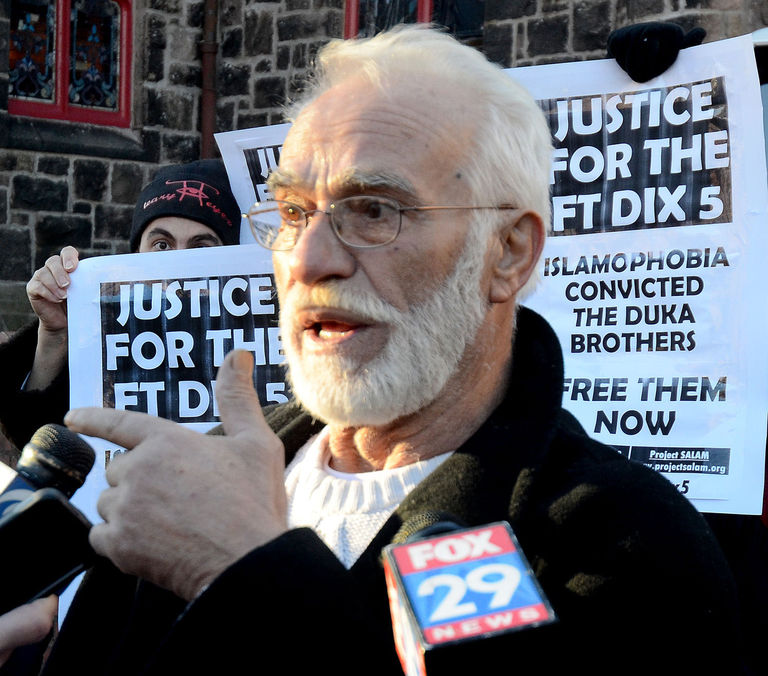
Ferik Duka, father of the Duka brothers, speaks at the demonstrations of supporters in front of the Camden Courthouse
More than 100 officers were dispatched to arrest those now called The Fort Dix 5 in a massive counter terrorist manhunt that targeted Dritan, Shain and Eljvir Duka and their two other co-defendants Mohamad Shnewer and Serdar Tatar in various locations in Cherry Hill, NJ, in 2007.
Republican candidate for U.S. President, NJ Governor Chris Christie—and known anti-Muslim bigot—prosecuted the original case.
The flaw in the convictions of these three ethnic Albanian brothers and their co-defendants, one Palestinian and one Turkish, is that they never even heard of the conspiracy that they are serving life in prison for. The so-called evidence is carefully parsed phrases gathered by FBI informants on a mission of entrapment.
“The philosophy that supports and encourages jihad around the world against Americans came to live here in New Jersey…” gloated Christie.
Yet, it should come to no surprise that a bigot like Christie who hates teachers and screams at child victims of hurricanes would also be bent on an anti-Muslim campaign to promote his philosophy encouraging racism and fear at the expense of locking up for life innocent immigrant Muslims living in New Jersey.
On Jan. 7, 2016, the three Duka brothers argued at a hearing at the federal court house in Camden, NJ, that they didn’t receive effective counsel and their court-appointed counsel convinced them to not testify at their trial despite the fact that they wanted to testify.
“Free the Dukas now! Free the Dukas now! Free the Dukas now!” shouted supporters at the Camden courthouse hearing—a hearing that was won due to the support for the Fort Dix 5 that confirms the bigotry of the courts and the politicians.
“My name is Zurata Duka. I am the mother of the three sons—Eljvir Duka, Dritan Duka and Shain Duka. My sons, you know, they are strong, but, you know, especially Dritan, he was for six years in solitary, and they was far away from me. It was very hard for me. And Eljvir, too, now he’s about two, three years in solitary there, you know. It’s like they’re making like a mental, you know—it’s not abuse, but it’s abuse by the brain. And it’s very, very hard for me to listen, to see my sons to suffer like this, when they are innocent,” said Zurata Duka to the supporters and the media in Camden.
The result of the hearing will be made known in March, but the need for growing action to support the Fort Dix 5 continues as the progressive movement stands with Muslim brothers against this extreme repression.
In recent months, on a personal level, my enthusiasm has
waned and unfortunately some of the goals we had for this year have not been
realized.Part of the reason is that I
have begun to question the effectiveness of what I was doing – are we affecting
policy?Are we building a base in the
communities?Are we making inroads with
the incarcerated?Are our information
channels being utilized, read, followed, forwarded?Are we connecting with like minded organizations
and individuals?Not having great answers to all these
questions – I got discouraged, lost enthusiasm and stopped doing some of the
things I was doing to try to keep the effort building.No doubt some momentum was lost accordingly.
I am now attempting to shake my self from this malaise and
get back into action.But in so doing –
I want to try to be somewhat more effective.It is a year and a half now since we began and we are no further along
with real Decarceration in NJ than when we started.We need to begin to change that.
Some of the steps I would like to take and see us take are:
1.Assess the organizations and individuals around
the state that have identified with our efforts and / or participated in them
and to figure out a way to develop roots in various communities around the state
so that there are free standing Decarceration efforts going forward and community
organizing committees.Toward these ends
I am urging everyone to complete the organizational membership form: https://docs.google.com/forms/d/1v-q3x7gnkq9PS_owE2nFfv_7k_eFQic94ZjycF6FXuA/viewform?edit_requested=true
2.Get standing committees in local communities to
agree to plan events.Have a targeted
set of dates for coordinated events.
3.Encourage organizations to adopt Decarceration positions
and have a place that makes all the statements accessible.
4.Get commitments from writers and content
producers to keep blog active.
5.Redouble efforts to reach out to thousands of
incarcerated in the NJ facilities.My
bet is that they do not know about our efforts.They are not yet engaged in our efforts and are not yet funneling
information to us about the injustices occurring on the inside.
6.Encourage the families to tell every story and
raise every cry for justice, relief from excessive sentences, release, an end
to neglect and abuse, etc.There should
be 1000s of justice campaigns in NJ and we should have a searchable database or
at least a common place for their stories.We need to lean into each other for mutual support so that the system
start to get the impression that it is are not taking out the incarcerated one
by one in isolation – but that when it messes with one – it messes with all –
that we will find out about it and act.
7.Produce the second issue of the NJ
Decarcerator.The second issue will
focus more on reach out to and incorporation into our efforts of the
incarcerated and their families.
I definitely want to get us back on track and believe the
premises of our organization and 6 point action plan still make sense.However I would like to see us lay down a
firmer foundation so that work can continue through committees and allied
organizations all over the state and so that we make Decarcerating the Garden
State a top priority for our communities to the point where inaction by those
political office holders will be at their own peril.
If you want to help with the effort and help get us
relaunched, please contact: Decarc@DecarcerateNJ.org
and also be sure to complete the membership form:
If you do not have time to read thisarticle – please at least sign and share the
petition that was started by Westminster Piano Major student Michael Roper:
This topic is admittedly tangential to the issue of mass
incarceration which this blog is dedicated to but it is relevant in that it
affects my Decarcerator activist son who is enrolled as a piano major at
Westminster Choir College.Son Robert has
played the role of trusted assistant in some of the decarceration eventsand performed – on piano and voice no less –
at one such event.
Westminster Choir College, an esteemed choir college that offers majors also in education, piano, organ, conducting, theory and other music disciplines
where Robert attends on a partial scholarship, has just announced that it is
eliminating the Piano Major from its curriculum.Since Robert is a senior the impact is less
damaging than it would be to those who are under class students.However it impacts him as well of course.
Westminster Choir College (WCC) with its small college
campus in Princeton is associated with the larger Rider University based in
Lawrenceville, NJ.
How The Cuts Hurt WCC
Any choir college worth its salt would have piano major
as part of the curriculum.Rider is saying - well we are still teaching the
piano primary course and still providing accompanists for the voice
students. However, pianists play a major role in the choral art - as does the voice conductor.The pianist is an integral part of the chorus
– in training – in accompaniment. Choral accompaniment is also a special art for pianists and for the chorus to survive, choral accompanists must also flourish. They are not separated.
It is also true that a piano degree is a solid asset in seeking employment at elementary, middle and high schools
where WCC likes to see itself as sending its graduates to teach chorus, The schools
want pianists that can competently accompany – not just that have had a primary
piano class during their 4-year stint.A
voice college that does not provide piano major is not teaching the entire
discipline.The Rider Administration does not get that as they probably just
look at how profitable the piano department is in making this decisions instead of viewing the piano major as an integral part of the whole of WCC.
The piano major curriculum provides students with courses
(Pedagogy, Piano Literature, Accompanying, Keyboard Skills, Ensemble), the skills
to earn a living as a successful musician. WCC piano majors not only
become good accompanists,
they become strong pianists that have a desire to perform and be able to teach
students of all ages and levels. Currently the department has students
that are teaching adult students under the leadership of professors that are
recognized leaders nationally in the field of Piano Pedagogy. That is an asset that Rider is wantonly lopping from the WCC curriculum.
In a letter sent to this writer, a professor of piano at WCC offered this comment:
"Piano majors inspire; they keep the academic, cultural and musical
environment in touch with the great repertoire that must be passed on to
the next generation. Piano majors, through their experiences with the
great repertoire, with learning to project infinite varieties in tone,
articulation, style, acquiring a virtuoso technique, they lead, not only
follow. They help a generation of parents too often lacking in
opportunities for lessons to see and hear their children grow their
facility at the piano, give performances that move audiences, learn to
pass this art on through ways of teaching children and adults privately
and in groups.
We have twice and four times
the number of students in some music programs that have not been cut. We
have a booklet full of piano alumni who hold leadership positions
throughout our country: professors, heads of departments, performers
getting D.M.A.'s, Directors of community music schools, presidents of
state and local music organizations, concert managers not to mention
private teachers with large studios, bringing knowledge of music, music
technology, and skills as well as the pure pleasure of being involve in
making music alone at the piano and with other pianists and other
musicians."
The Beginning of the End of WCC?
In all likelihood, this cut is writing on the wall for
WCC.It shows that Rider has no
commitment to teach the full discipline of voice which includes piano majors – who can competently accompanytop notch choirs.It is a shot across the bow from an
administration that apparently wants to get out of arts and music education all
together and would prefer to gear toward business endeavors.The defense of the piano major at WCC is
equivalent to the defense of the college itself and the defense of the voice
discipline.Ridding of the piano major
begins to move WCC toward second rate and once that disintegration begins the
administration will point to it to further undermine the WCC mission and the
voice discipline.If this goes through –
it will likely lead to a chipping away – at the organists, the conductors, the
theorists . . . it is the beginning of the end of the Westminster Choir
College.It is THAT significant.
Future Recruitment – You Mean They Don’t Even Have a Full
Piano Department and Piano Major?
The administration apparently did the math and they think
the piano major does not add up for them.However in their efforts to recruit the best students, the word will get
out that “WCC Don’t Even Have a Piano Major!”There will be a slipping and sliding in the evaluation process.The university will still try to market
itself and possibly use half truths to get the students in the door – like it
did to those who it is abandoning with this decision.However this will certainly hurt the
reputation of WCC as an esteemed choir college.
How The Cuts Hurt Students
The cuts are announced to immediately impact Freshman and
Sophomores – and it is said that Juniors and Seniors will be able to finish
their degreed program at WCC.1st
and 2nd year piano students now are expected to transfer out of
WCC.That is quite the outrage.In some cases that means that Rider is
refusing to honor 4 year scholarships that it has rewarded.That is a financial deception by the Rider
Administration!
It also is devastating as these students were recruited to a
school with a 4 year program.They no
doubt passed up many opportunities of comparable worth based upon the implied
promise of a degreed piano major program.They were deceived and lied to by the Rider administration which now is
reneging on its promise to these students.They no doubt passed up scholarship opportunities from other schools
*that now are no longer available* - especially as transfers.The slots themselves are likely not available
as well.The recruitment of these
students occurred under false pretenses now that the administration has
unveiled this cut to the Piano degree.
However this is a problem for the Juniors and Seniors as
well in many ways.One of the
attractions of a university especially in the music field is for opportunities
in the graduate department.So as the
major is cut, graduate lines of study in the major are also impacted as
well as career path opportunities within the department in support of the
undergraduate programs.Furthermore the
savaging of the piano staff eliminates the post graduate support the university
is capable of providing to its recent graduates.
Further those that graduate from WCC as piano
majors this year and next, when they go afield professionally, they will be up
against other graduates from conservatories with esteemed intact piano
departments and the question will be in the minds of the interviewers asto
the worthiness of the program that has now been eliminated.Was it in decline?It is an across the board besmirching of the
WCC piano major and a blemish even for the seniors and 3rd year
students.
3rd and 4th year students were also
harmed, along with the first and 2nd year students, in having been
sold a bill of goods by the university in the decision to come to WCC for their
piano major study.They were sold the
full package and nobody in their right mind would select a university program
if they are told by the university – “oh and by the way – we will be
eliminating this offering when you are some part way through your study here so
make sure you make alternate plans as to where to finish up and also do not
count on any graduate opportunities in your field or on any career support post
graduation.”
In effect though that is the predicament that this
administration has now placed these students – it is a classic bait and shift
operation – unworthy for an esteemed music college.
One intention apparently of the administration in announcing
this cut (as well as cuts to several other majors) is to attempt to focus
attention – blame – on the Rider University faculty that fought strong last
year against attempts by administration to force a strike and severely
downgrade the value of a Rider University degree by degrading the faculty. This intention is made clear in the news
reporting on the cuts where the administration references “instructional costs”
as a scapegoat for its ill-advised action.
This action by administration is retaliatory to the faculty
for holding the line last year when the administration tried to strong arm it
to accept changes that would have severely degraded the quality of education at
Rider.The faculty and union united to
save the university from the predatory number crunchers in administration – and
now the administration wants to put the squeeze on.It is also likely leveraging these cuts as a
means to force what will likely be significant tuition hikes in the future and
it wants to mute opposition by creating a climate of fear of even more cuts.
As the faculty representative is quoted:
"Our first take on it was this is not necessary," said Jeff Halpern,
contract administrator and chief grievance officer for the faculty
union. "A major restructuring without any conversations with the faculty
is simply formula for disaster."
"Institutions like Rider really live and die on the relationship between
faculty and students," Halpern said. "I can only say that our faculty
is dispirited, morale is completely destroyed, and I don't see how that
can be a positive thing."
Coincidentally, the student that happened to be one of the most
outspoken in support of faculty, to the point of actually being rewarded by the
faculty union last year at their ratification meeting, happens to be a piano
major, none other than son Robert.Robert organized a meeting on the WCC campus, led a petition of parents
and students in support of faculty, leafleted both campuses calling for
university wide student strike should Rider force faculty to strike, organized
picketing training on the Lawrenceville campus and recorded Which Side Are You
On Rzewski variations, a performance that appeared at the faculty union’s
website for months and helped inspire unity of the faculty.
The targeting of the piano major for
termination by the Rider Administration after it was challenged effectively
last year by a student in that major is coincidental .However, it is clear that administration
wants to drive a wedge between faculty and the students with these cuts – as it
places the blame for its mismanagement on faculty and “instructional costs.”
In any event, WCC students, faculty, parents, and allies at
the Rider Lawrenceville campus need to UNIFY.The Faculty organizations including AAUP need to get behind the efforts
to PUT A STOP TO THIS ADMINISTRATION’S SCAPEGOATING of faculty for its own
mismanagement and TO SAVE THE PIANO MAJOR at WCC.
Suggested actions:
Sign and circulate the petition including going door to door
with a lap top or your phone to in your dorms and faculty conference rooms and
get your colleagues to sign.
Write letters to administration and in the Rider paper and
in other media outlets, blog articles and other communiques in support of the
piano program.
Piano majors, post your performance youtube videos with the
HT #WCCEndangeredSpecies .
Hold meetings on campus and even consider protest actions on
the campuses – at events.Leaflet the
Christmas concert.